
Arctic Liner Shipping to Become Viable around 2040, Suez Set for Two More Decades
Post date: 05.02.2016 , Views: 308
Home > Maritime news > Arctic Liner Shipping to Become Viable around 2040, Suez Set for Two More Decade...
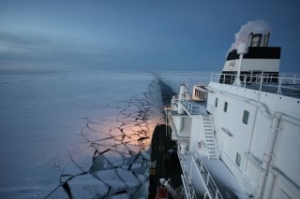 Gazprom The likelihood of the Northern Sea Route (NSR) to replace the Suez Canal in the transportation of the containerized goods is far off, at least for the next two decades, a study shows. Namely, according to the findings from a new report by Copenhagen Business School’s Maritime Division, Arctic liner shipping may become economically feasible around 2040, if the ice cover continues to diminish at the present rate. In addition, the sector of dry bulk and offshoring are currently the sectors with the largest potential as the Arctic hosts and abundance of the natural resource. The NSR has the potential to reduce the distance between Europe and Asia by up to 40 per cent, compared to the contemporary Suez Canal. However, the possibility of a major expansion of the maritime activities within the sectors of bulk, offshoring and liner shipping before midcentury rests upon several crucial assumptions which are all subject to major uncertainties. The study shows that these uncertainties include the hazardous environmental conditions, port and infrastructure availability and high costs of operation compared to the southern shipping lanes. Additionally, the Arctic Ocean lacks an international governmental and regulative framework that in combination with high entry costs creates uncertainty for the maritime industry seeking to operate in and around the Arctic Ocean. In addition, in order for liner shipping through the Arctic to become more than a niche market, conditions must allow larger vessels to operate along the NSR. For the time being, investment in an ice reinforced container ship would not be advantageous to that of an ordinary vessel within the next decades. The study claims that this is in large part due to the significant fuel consumption stemming from the hull alterations of vessels operating in ice filled waters.