
European Shipowners Call for More Clarity on Scrubbers
Post date: 09.10.2014 , Views: 287
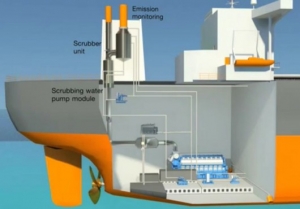 The EU Sulphur Directive requires that, as of 1 January 2015, all ships sailing in the SECAs (Sulphur Emission Control Areas the Channel, the North Sea and the Baltic Sea) use bunker fuels with a maximum sulphur content of 0.1% or that the same level of emissions is reached by the use of alternative fuels or compliant abatement technologies.
Scrubbers have been identified as one of the few abatement technologies available that allow ships to reduce the sulphur content in their emissions.
The EU Water Framework Directive (WFD) is a source of concern for European shipowners as it sets limits for the content of pollutants in ports, estuaries and coastal areas. This in turn means that the discharges of washwater will in some areas be well under the limits set by the WFD, while in other areas with poorer water quality, washwater discharges might be prohibited by Member State legislation. The resulting lack of harmonisation and clarity will without a doubt hamper the uptake of scrubber technology, European Community Shipowners Associations (ECSA) said in a release.
What is more, as stressed by ECSA, the WFD foresees a progressive reduction of some substances and a complete phasing out of others. However, due to a lack of information on the actual composition of washwater discharges, it is currently not possible to ascertain whether scrubber discharges fall within the two aforementioned categories. Hence, more scientific research on the actual ecological effects of scrubber discharge is necessary, ECSA added.
Patrick Verhoeven, ECSA Secretary-General said: “The current uncertainty jeopardises investments already made by shipowners eager to meet the compliance criteria before the fast-approaching deadline of 1 January 2015, but more importantly hinders the commissioning of future scrubber installations.
Any restriction of the use of scrubber technology should in our view be preceded by a scientific assessment with any changes in the approval procedure of such systems reflected under IMO rules. Also, shipowners that have already committed to a scrubbing system should not be disproportionately penalised.”