
Shipwreck Exploring Robotic Turtle to Premiere at London Exhibition
Post date: 27.11.2013 , Views: 234
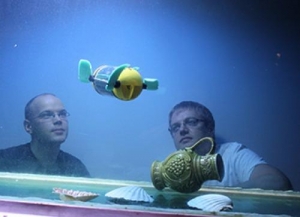 The Robot Safari exhibition in London Science Museum will see the world premiere of the underwater robot U-CAT, a highly maneuverable robotic turtle developed at Estonia's Tallinn University of Technology, and designed to penetrate shipwrecks. U-CAT’s locomotion principle is similar to sea turtles. Independently driven four flippers make the robot highly maneuverable; it can swim forward and backward, up and down and turn on spot in all directions. Maneuverability is a desirable feature when inspecting confined spaces such as shipwrecks. The robot carries an onboard camera and the video footage can be later used to reconstruct the underwater site.
“The so called biomimetic robots, robots based on animals and plants, is an increasing trend in robotics where we try to overcome the technological bottlenecks by looking at alternative technical solutions provided by nature ”, explains Prof. Maarja Kruusmaa, a Head of Centre for Biorobotics.
Underwater robots are nowadays mostly exploited in oil and gas industry and in defense. These robots are too big and also too expensive to be used for diving inside wrecks. Shipwrecks are currently explored by divers, but this is an expensive and time consuming procedure and often too dangerous for the divers to undertake. U-CAT is designed with the purpose of offering an affordable alternative to human divers.
U-CAT is part of an EU funded research project ARROWS, which is developing technologies to assist underwater archaeologists. The technologies of the ARROWS project will be tested in the Mediterranean Sea and in the Baltic Sea, two historically important but environmentally different regions of Europe.
In London Science Museum, the team will show the U-CAT robot as well as its interactive downscaled models u-CATs operating in an aquarium. Robot Safari is open for visitors from 28 November to 1 December, 2013.