
Space@Sea to Introduce Floating Islands
Post date: 03.11.2017 , Views: 187
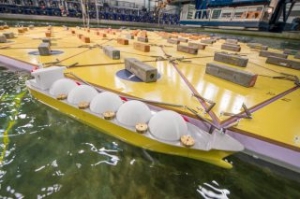 MARIN The consortium consisting of seventeen European partners intends to develop a standardized and cost-efficient modular island with low ecological impact, providing sustainable and affordable workspace at sea. As of November 1, the Horizon 2020 funded project Space@Sea will make a step in the efficient use of the maritime environment. The three-year project can be regarded as a success if the modular design of the multi-use platform has successfully been validated in a relevant environment at model scale, Maarten Flikkema, project coordinator, Maritime Research Institute Netherlands (MARIN), commented. As explained, Space@Sea is to study the most suitable shape of the floaters to minimize the motions. As a starting point, triangles will be used which also allow for a modular design maximizing the flexibility to add and remove deck space and applications if necessary. Offshore specialists will also design a shared mooring solution in combination with a remote monitoring and sensing system to reduce installation and maintenance costs. In Space@Sea, four applications will be studied including farming, transport and logistics hub, energy hub and living. To show the potential of multi-use modular floating islands, the project will conclude with the evaluation of three business cases with combinations of applications for various locations throughout Europe. The project is partly funded by EU’s Horizon 2020 research program. Partners working together in this MARIN coordinated project are Deltasync, DST, Nemos, TU Delft, Mocean Offshore, TU Hamburg Harburg, Bluewater Energy Services, University of Rostock, Gicon-Grossmann, Wageningen University, University Duisburg-Essen, TU Graz, Waterstudio, Icepronav, Val Fou and DEME.